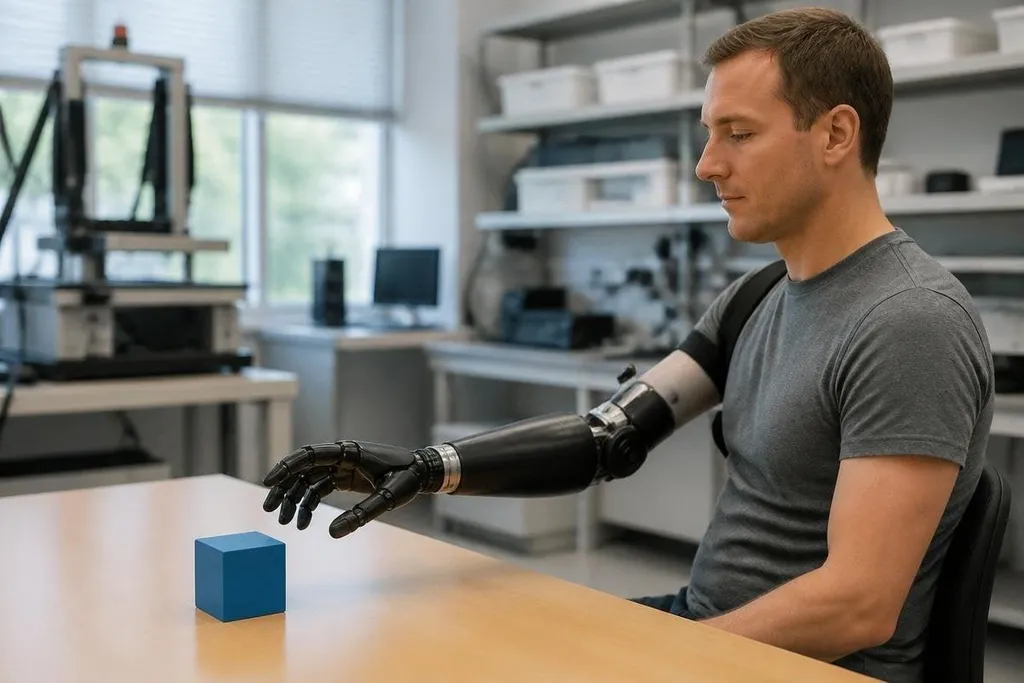
A robotic limb has to do more than move when a person gives a command. To feel natural, it must read the user’s intent, move with the body, and send useful feedback back to the nervous system.
That makes the main problem clear: a robotic arm can lift an object, but the user also needs to know where the hand is and how hard it is holding.
- Nerve or muscle signals can tell the limb what movement the user wants.
- Motors and joints turn that signal into physical motion.
- Pressure and position sensors can send information back to the user.
Reading the movement a person wants
A prosthetic limb can receive signals from muscles near the amputation site. When the person tries to close their missing hand, those muscles may still produce electrical activity. Sensors can measure that activity and send it to a controller.
The controller then selects an action, such as opening the hand, closing the fingers, or turning the wrist. The quality of that movement depends on the signal. A weak or changing signal can make the limb move slowly, stop early, or choose the wrong action.
Some systems may use signals from nerves instead of surface muscle activity. That approach can give the controller a closer link to the person’s original movement plan.
It also requires careful surgery, training, and long-term monitoring. The exact results depend on the person, the implant, and the control system.
Turning intent into motion
The next step is mechanical. Motors move joints through gears, cables, or direct drives. A hand may need several motors because the thumb and fingers must move in different ways when the user pinches, grips, or releases an object.
Position sensors tell the controller where each joint is. Force sensors can measure pressure at the fingertips or inside the socket. The controller uses these readings to adjust motor output while the limb is moving.
That adjustment matters because the same grip does not work for every object. A paper cup needs less force than a metal tool. Too little force drops the object. Too much force crushes it.
Touch is the missing part
Most people do not watch their hand every second. They know where it is because the brain receives signals from muscles, joints, and skin. For that body sense, the system needs a replacement.
Researchers can connect pressure sensors to electrodes that stimulate nerves. The user may then receive a signal linked to contact or force. The signal may not feel exactly like normal touch, but it can help the person control the limb without watching every movement.
A dated prosthetic limb report from Robot24.com can name the device, neural interface, trial setting, and measured result, so you can judge whether the feedback helped someone move.
Feedback also has to arrive at the right time. A delay between touching an object and feeling the signal can make the hand harder to control. A signal that is too strong, too weak, or hard to tell apart from other signals adds another problem for the user.
What still limits natural movement
The body has many ways to sense motion. A robotic limb may measure only a small part of that information. The user may feel pressure but still lack a clear sense of joint angle, temperature, texture, or the limb’s weight.
The socket creates another limit. It must hold the limb firmly while avoiding painful pressure on the skin. Changes in swelling, sweat, or body position can affect the fit and change how signals reach the controller.
Training also takes time. The user must learn which signal produces each movement, while the system must adjust to changes in muscle activity. A demonstration can show a successful grasp, but it does not prove that the same control works during a full day of ordinary tasks.
Cost, surgery, maintenance, and battery life shape the choice too. A system that gives better feedback may need implanted parts, extra electronics, and clinical support. That can make repair harder and limit access.
I'd judge a robotic limb by how well it handles small daily actions, such as picking up a cup, turning a key, or carrying a bag, rather than by one clean demonstration.
A practical check before trusting the claim
Use these points when you assess a new robotic limb or research result:
- Signal source: Check whether control comes from surface muscles, implanted nerves, or another input.
- Movement range: Look for the joints and actions shown, not a general claim about natural motion.
- Touch feedback: Ask what the user can feel and how the system creates that signal.
- Test setting: Separate a controlled lab task from repeated use during daily activities.
- Long-term care: Check the socket, battery, repairs, software updates, and clinical support.
- Open result: Find out which parts remain unproven, especially comfort and control over time.
The next useful test is not a faster robot hand. It is a limb that lets a person control force, sense position, and repeat ordinary tasks without constant visual checks.